Why Can Dehydration Be Such a Life-threatening Event
Original Editors - Jordan Dellamano Daniel McCoy from Bellarmine University's Pathophysiology of Complex Patient Problems project.
Acme Contributors - Lydia Marie Coots, Jordan Dellamano, Daniel McCoy, Courtney Campbell, Kim Jackson, Vidya Acharya, Elaine Lonnemann, Lucinda hampton, Scott Buxton, Admin, Wendy Walker, WikiSysop, Rachael Lowe and Tony Lowe
Introduction [edit | edit source]

Dehydration occurs when the trunk loses more fluid than it takes in. This condition can result from disease; a hot,dry climate; prolonged exposure to sun or high temperatures; not drinking enough water; and overuse of diuretics or other medications that increment urination. Aridity can upset the delicate fluid-table salt balance needed to maintain healthy cells and tissues.
- Water accounts for about sixty% of a homo's body weight. Information technology represents about l% of a woman'due south weight.
- Young andmiddle-aged adults who drink when they're thirsty do not generally take to practise anything more than to maintain theirbody'south fluid residuum.
- Children need more h2o considering they expend more energy, but most children who drinkwhen they are thirsty go as much water as their systems crave.
- Historic period and aridity: Adults over the age of 60 who potable only when they are thirsty probably get just near xc% of the fluid they need.
- Dehydration in children usually results from losing large amounts of fluid and non drinking enough water to replacethe loss. This status generally occurs in children who have stomach flu characterized by vomiting and diarrhoea, or who can not or will not have enough fluids to recoup for excessive losses associated with feverand sweating of acute affliction.
- An infant can become dehydrated only hours later on becoming ill. Dehydration is amajor cause of infant illness and death throughout the world.[1]
In that location are three principal types of dehydration: hypotonic (primarily a loss of electrolytes), hypertonic (primarily loss of h2o), and isotonic (equal loss of water and electrolytes). The most commonly seen in humans is isotonic. [2]
Etiology [edit | edit source]
Body water is lost through the skin, lungs, kidneys, and GI tract. The loss of body water without sodium causes dehydration.
- Water is lost from the skin, lungs, gastrointestinal tract, and kidneys.
- Aridity results when h2o losses from the body exceed h2o replacement.
- Information technology may be caused by failure to supercede obligate water losses.
There are several forms of dehydration.
- Isotonic water loss occurs when water and sodium are lost together. Causes of isotonic h2o loss are vomiting, diarrhea, sweating, burns, intrinsic kidney affliction, hyperglycemia, and hypoaldosteronism.
- Hypertonic dehydration occurs when water losses exceed sodium losses. Serum sodium and osmolality will always be elevated in hypertonic aridity. Backlog pure water loss occurs through the skin, lungs, and kidneys. Etiologies are fever, increased respiration, and diabetes insipidus.
- Hypotonic dehydration is mostly caused past diuretics, which cause more than sodium loss than h2o loss. Hypotonic dehydration is characterized by low sodium and osmolality.
The source of water loss relates to the etiologies of aridity:
- Failure to supplant h2o loss: altered mentation, immobility, dumb thirst mechanism, drug overdose leading to blackout
- Excess water loss from the skin: rut, exercise, burns, severe skin diseases
- Excess water loss from the kidney: medications such as diuretics, acute and chronic renal illness, postal service-obstructive diuresis, salt-wasting tubular disease, Addison disease, hypoaldosteronism, hyperglycemia
- Excess h2o loss from the GI tract: airsickness, diarrhea, laxatives, gastric suctioning, fistulas
- Intraabdominal losses: pancreatitis, new ascites, peritonitis
- Excess insensible loss: sepsis, medications, hyperthyroidism, asthma, chronic obstructive pulmonary disease (COPD), drugs[3]
Prevalence [edit | edit source]
- Salubrious adults with admission to water rarely become dehydrated.
- Whatever adult may develop dehydration as a complexity of an affliction such as hyperglycemia.
- Data shows that older adults are more likely to develop aridity. The elderly population is besides 20% to 30% more prone to developing dehydration due to immobility, impaired thirst mechanism, diabetes, renal disease, and falls.[iv]
Characteristics/Clinical Presentation [edit | edit source]
Increased thirst, dry oral cavity, light-headedness, fatigue, impaired mental focus, low urine output, dry out skin, disability to produce tears, sunken eyes are the signs of aridity. [5]
| Mild Aridity | Moderate Dehydration | Severe Dehydration |
|
|
|
Increased tiredness, headaches, nausea, and paresthesias are experienced at about 5% to 6% water loss. With x% to 15% fluid loss, may experience symptoms of muscle cramping, dry and wrinkly skin, beginning of delirium, painful and/or decreased urine output, and decline in eyesight. Losses of water greater than 15% are commonly fatal[7].
When to seek medical attention [edit | edit source]
- Abiding or increased airsickness for greater than a 24 hour period
- Diarrhoea greater than two days
- Fever over 101o degrees
- Decreased urine production
- Weakness
- Confusion [8]
Diagnostic Tests [edit | edit source]
Both concrete and mental exams assist to diagnose dehydration.
- A patient presenting symptoms such as disorientation, low blood pressure, rapid heartbeat, fever, lack of sweat, and inelastic skin will usually be considered dehydrated.
- Blood tests are oft employed to examination kidney function and to check sodium, potassium, and other electrolyte levels (chemicals that regulate hydration in the body and are crucial for nerve and musculus role). A urine assay will provide very useful information to help diagnose dehydration. In a dehydrated person, urine will be darker in color and more concentrated.
- To diagnose dehydration in infants, doctors commonly bank check for a sunken soft spot on the skull. They may also look for a loss of sweat and sure musculus tone characteristics.[2]
Complications [edit | edit source]
If dehydration is not checked, information technology can pb to serious complications; these can include:
- Depression blood volume – less blood produces a drop in blood pressure and a reduction in the amount of oxygen reaching tissues; this can be life threatening.
- Seizures – due to an imbalance of electrolytes.
- Kidney problems – including kidney stones, urinary tract infections, and eventually kidney failure.
- Heat injury – ranging from mild cramps to heat exhaustion or fifty-fifty oestrus stroke[9].
Differential Diagnosis [edit | edit source]
- The principle differential of dehydration in adults is the loss of body water versus the loss of blood.
- This is important because claret loss should be replaced with blood, while water loss should exist replaced with fluid.
- The next betoken to consider is the differential diagnosis of the crusade of dehydration (run across Etiology higher up)[3]
Handling [edit | edit source]
Aridity must exist treated past replenishing the fluid level in the body. This can be done by consuming clear fluids such as h2o, clear broths, frozen h2o or ice pops, or sports drinks (such as Gatorade). Some dehydration patients, even so, will require intravenous fluids in club to rehydrate. People who are dehydrated should avoid drinks containing caffeine such as coffee, tea, and sodas.
Underlying conditions that are causing dehydration should likewise be treated with the advisable medication. This may include medication available to purchase over-the-counter or online, such as anti-diarrhea medicines, anti-emetics, and anti-fever medicines.[two]
Concrete Therapy Management & Prevention [edit | edit source]
At that place is no direct physical therapy intervention for dehydration in the severe category; however, prevention and fluid replacement orally is something physical therapists can influence through patient pedagogy.
Patients should be educated virtually the signs and symptoms of dehydration in order to know when they may need to seek help. This is done by proper knowledge of hydration[ten].
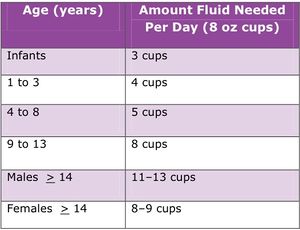
Ecology Factors [10] [edit | edit source]
Heat[11]
- Being outside on a hot or boiling day tin can cause your body to need more fluids
- It is recommended by the American Heart Association to drink h2o before being outdoors in the heat. This manner you do not have to play catch upwardly with Hydration when strain has already been placed on the heart.
Cold[12]
- Fluid intake also needs to be increased in cooler environments.
- Cool temperatures may blunt thirst
- Inhalation of cold, dry air increases warmth and moisture in the lungs which causes water vapor to be exhaled
- Physical Activity in the cold can increment respiratory h2o losses past 15-45 mL per hour
- Insulated clothing tin can likewise increment perspiration, increasing water loss
Hydration and Exercise
Earlier practice: Potable 12-20oz of fluid ii hours leading up to exercise
During Practice:
- <i-hr drink 16-30 oz of h2o
- 1-3 hours drink xvi-30 oz half dozen-8% CHO, sodium drinkable per hour of do
- >three hours similar to guidelines for 1-3 hours but increase sodium intake
Avoid caffeine or alcohol in beverages due to their diuretic effects
Avoid hyponatremia which tin occur by drinking besides much fluid. therefore, diluting sodium
Monitor dehydration with changes in body weight and urine color. Each pound lost during exercise, drinkable 15-16oz of fluid[13]
Resources [edit | edit source]
- Dehydration Fact Sheet
- Aridity and the Influenza
- Dehydration in the Elderly
- Rehydration and children
References [edit | edit source]
- ↑ The free lexicon Dehydration Bachelor: https://medical-lexicon.thefreedictionary.com/dehydration (accessed 12.7.2021)
- ↑ 2.0 2.one 2.ii Aridity-What is Dehydration?. News-medical website. Available at: http://world wide web.news-medical.cyberspace/health/Dehydration-What-is-Dehydration.aspx. Accessed on March 30, 2017.
- ↑ 3.0 three.1 Taylor Yard, Jones EB. Adult Dehydration. InStatPearls [Internet] 2022 Mar 24. StatPearls Publishing.Available from:https://www.statpearls.com/articlelibrary/viewarticle/37754/ (last accessed 18.11.2020)
- ↑ Taylor K, Jones EB. Adult Dehydration. [Updated 2022 May nineteen]. In: StatPearls [Internet]. Treasure Isle (FL): StatPearls Publishing; 2022 Jan Available: https://world wide web.ncbi.nlm.nih.gov/books/NBK555956/ (accessed 12.7.2021)
- ↑ http://survivalscoop.blogspot.com/2010/08/signs-of-aridity-why-yous-need-h2o.html
- ↑ half-dozen.0 half-dozen.1 6.2 half dozen.3 6.4 Goodman, C., & Snyder, T. (2013). Differential diagnosis for physical therapists: Screening for referral. (fifth edition ed., pp. 171). St. Louis, MO: Saunders.
- ↑ Aridity: Why is it then dangerous? Rehydrate website. 2012. Available at: rehydrate.org/dehydration/alphabetize.html (Accessed Apr 3, 2017)
- ↑ Dehydration-Home Treatment. WebMD Website. Available at http://www.webmd.com/fitness-practice/tc/dehydration-home-treatment#1 (2015)Accesed March 30,2017.
- ↑ Medical News Today Dehydration Bachelor: https://www.medicalnewstoday.com/articles/153363#complications (accessed 12.7.2021)
- ↑ 10.0 10.one Center for Disease Control. Dengue Clinical Case Direction East-learning: Hydration Status. https://www.cdc.gov/dengue/training/cme/ccm/Hydration%20Status_F.pdf (assessed 3 Apr 2017)
- ↑ 20. American Heart Association. Staying Hydrated-Staying Healthy. (2014) Available at http://world wide web.center.org/HEARTORG/HealthyLiving/PhysicalActivity/FitnessBasics/Staying-Hydrated---Staying-Healthy_UCM_441180_Article.jsp#.WOWKD5H3ahA Accessed on March 30, 2017
- ↑ Quaglio Fifty. The Dehydration Equation. American Fitness. Winter2017. Available from: SPORTDiscuss with Total Text. Accessed on March 30,2017.
- ↑ Pariser Thou. Nutrition for Practice Performance. Powerpoint Presentation Given at Bellarmine University Spring 2016.
Source: https://www.physio-pedia.com/Dehydration

Post a Comment for "Why Can Dehydration Be Such a Life-threatening Event"