Qualifications for House of Representatives in the Philippines
| Congress of the Philippines Kongreso ng Pilipinas | |
|---|---|
| 18th Congress of the Philippines | |
  Seals of the Senate (left) and of the House of Representatives (correct) | |
| Type | |
| Type | Bicameral |
| Houses | Senate Business firm of Representatives |
| History | |
| Founded | June ix, 1945 (1945-06-09) |
| Preceded past | National Associates of the Philippines |
| New session started | July 22, 2019 (2019-07-22) |
| Leadership | |
| President of the Senate | Tito Sotto, NPC |
| Speaker of the House of Representatives | Lord Allan Velasco, PDP–Laban |
| Construction | |
| Seats | 328 (see list) 24 senators 304 representatives |
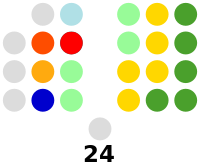 | |
| Senate political groups | Bulk bloc (xx)
Minority bloc (4)
|
 | |
| Business firm of Representatives political groups | Bulk bloc (268)
Minority bloc (25)
Independent minority bloc (5)
Vacancies (6)
|
| Joint committees | Joint committees are chaired by senators |
| Authority | Commodity Half-dozen of the Constitution of the Philippines |
| Elections | |
| Senate voting arrangement | Multiple not-transferable vote |
| Business firm of Representatives voting system | Parallel voting (Party-list proportional representation and first-by-the-post) |
| Senate concluding ballot | May 13, 2019 |
| Business firm of Representatives last ballot | May 13, 2019 |
| Senate next election | May nine, 2022 |
| House of Representatives next ballot | May nine, 2022 |
| Coming together identify | |
 | |
| Joint sessions are normally held at the Batasang Pambansa Circuitous, Quezon City | |
| Website | |
| Senate of the Philippines Business firm of Representatives of the Philippines | |
The Congress of the Philippines (Filipino: Kongreso ng Pilipinas) is the bicameral legislature of the Philippines. Information technology consists of the Senate (upper house) and the House of Representatives (lower business firm),[ane] although colloquially, the term "Congress" commonly refers to just the latter.[a]
The Senate is equanimous of 24 senators[2] half of which are elected every three years. Each senator, therefore, serves a total of six years. The senators are elected by the whole electorate and do not stand for any geographical district.
In the ongoing 18th Congress, at that place are 304 seats in the House of Representatives. The Constitution states that the House "shall be composed of not more than than 250 members, unless otherwise fixed by law," and that at least 20% of it shall be sectoral representatives. There are two types of congressmen: the district and the sectoral representatives. At the time of the ratification of the constitution, there were 200 districts, leaving 50 seats for sectoral representatives.
The district congressmen represent a particular congressional district of the country. All provinces in the country are equanimous of at least one congressional district. Several cities also accept their ain congressional districts, with some having two or more representatives.[1] From 200 districts in 1987, the number of districts take increased to 243. Every new Congress has seen an increment in the number of districts.
The party-list congressmen represent the minority sectors of the population. This enables these minority groups to be represented in the Congress, when they would otherwise not be represented properly through district representation. Likewise known equally political party-list representatives, sectoral congressmen represent labor unions, rights groups, and other organizations.[1] With the increase of districts as well means that the seats for political party-listing representatives increase as well, as the 1:4 ratio has to be respected.
The Constitution provides that Congress shall convene for its regular session every year beginning on the quaternary Monday of July. A regular session can concluding until thirty days before the opening of its next regular session in the succeeding year. The president may, all the same, call special sessions which are ordinarily held between regular legislative sessions to handle emergencies or urgent matters.[1]
History [edit]
Spanish era [edit]
During the Spanish colonization of the Philippines, municipal governments, or Cabildos were established. I such instance was the Cabildo in Manila, established in 1571.[3]
When the Philippines was under colonial rule as role of the Spanish East Indies, the colony was non given representation to the Spanish Cortes. It was only in 1809 where the colony was made an integral part of Spain and was given representation in the Cortes. While colonies such as the Philippines were selecting its delegates, substitutes were named then that the Cortes tin can convene. The substitutes, and first delegates for the Philippines were Pedro Pérez de Tagle and José Manuel Couto. Both had no connections to the colony.[4]
By July 1810, Governor General Manuel González de Aguilar received the education to hold an election. As simply the Manila Municipal Council qualified to elect a representative, it was tasked to select a delegate. Iii of its representatives, the governor-general and the Archbishop of Manila selected Ventura de los Reyes as Manila's delegate to the Cortes. De los Reyes arrived in Cadiz in December 1811.[iv]
However, with Napoleon I'due south defeat at the Boxing of Waterloo, his brother Joseph Bonaparte was removed from the Spanish throne, and the Cádiz Constitution was replaced by the Cortes on May 24, 1816, with a more conservative constitution that removed Philippine representation on the Cortes, among other things. Restoration of Philippine representation to the Cortes was 1 of the grievances by the Ilustrados, the educated grade during the late 19th century.[2]
Revolutionary era [edit]
The Illustrados' campaign transformed into the Philippine Revolution that aimed to overthrow Castilian rule. Proclaiming independence on June 12, 1898, President Emilio Aguinaldo and so ordered the convening of a revolutionary congress at Malolos. The Malolos Congress, among other things, approved the Malolos Constitution. With the approving of the Treaty of Paris, the Spanish ceded the Philippines to the United States. The revolutionaries, attempting to foreclose American conquest, launched the Philippine–American War, but were defeated when Aguinaldo was captured in 1901.[ii]
American era [edit]
When the Philippines was under American colonial dominion, the legislative body was the Philippine Commission which existed from 1900 to 1907. The President of the The states appointed the members of the Philippine Committee. Furthermore, 2 Filipinos served as Resident Commissioners to the House of Representatives of the United States from 1907 to 1935, then only one from 1935 to 1946. The Resident Commissioners had a voice in the House, but did not have voting rights.[two]
The Philippine Bill of 1902 mandated the creation of a bicameral or a ii-chamber Philippine Legislature with the Philippine Committee every bit the Upper House and the Philippine Assembly every bit the Lower House. This bicameral legislature was inaugurated in 1907. Through the leadership of and then Speaker Sergio Osmeña and so-Floor Leader Manuel L. Quezon, the Rules of the 59th United states of america Congress were substantially adopted equally the Rules of the Philippine Legislature.[ii]
In 1916, the Jones Law changed the legislative system. The Philippine Committee was abolished, and a new bicameral Philippine Legislature consisting of a House of Representatives and a Senate was established.[2]
Republic and Second Republic era [edit]
The legislative system was changed again in 1935. The 1935 Constitution, aside from instituting the Commonwealth which gave the Filipinos more role in government, established a unicameral National Assembly. But in 1940, through an amendment to the 1935 Constitution, a bicameral Congress of the Philippines consisting of a House of Representatives and a Senate was created. Those elected in 1941 would non serve until 1945, equally World War 2 erupted. The invading Japanese fix the Second Philippine Republic and convened its ain National Assembly. With the Japanese defeat in 1945, the Commonwealth and its Congress was restored. The same setup continued until the Americans granted independence on July 4, 1946.[2]
Independent era [edit]
Upon the inauguration of the Commonwealth of the Philippines on July four, 1946, Republic Human activity No. six was enacted providing that on the engagement of the declaration of the Republic of the Philippines, the existing Congress would be known as the First Congress of the Republic. Successive Congresses were elected until President Ferdinand Marcos declared martial police force on September 23, 1972. Marcos then ruled by decree.[2]
As early as 1970, Marcos had convened a constitutional convention to revise the 1935 constitution; in 1973, the Constitution was approved. It abolished the bicameral Congress and created a unicameral National Assembly, which would ultimately be known as the Batasang Pambansa in a semi-presidential system of authorities. The batasan elected a prime government minister. The Batasang Pambansa first convened in 1978. [two]
Marcos was overthrown later on the 1986 People Ability Revolution; President Corazon Aquino then ruled past decree. Later that yr she appointed a constitutional commission that drafted a new constitution. The Constitution was approved in a plebiscite the next year; it restored the presidential system of government together with a bicameral Congress of the Philippines. It outset convened in 1987.[two]
Seat [edit]
Locations of the historical (blue) and electric current (cerise) seats of Congress in Metro Manila.
The two houses of Congress run into at dissimilar places in Metro Manila, the seat of government: the Senate meets at the GSIS Building, the main office of the Government Service Insurance System (GSIS) at Pasay, while the House of Representatives sits at the Batasang Pambansa Complex in Quezon Metropolis. The ii are around 25 kilometers (16 mi) apart.
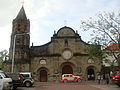

The Barasoain Church building in Malolos, Bulacan served every bit a coming together place of unicameral congress of the Starting time Philippine Republic.
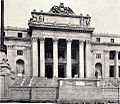
After the Americans defeated the Get-go Commonwealth, the Us-instituted Philippine Legislature convened at the Ayuntamiento in Intramuros, Manila from 1907 to 1926, when it transferred to the Legislative Edifice but outside Intramuros. In the Legislative Edifice, the Senate occupied the upper floors while the House of Representatives used the lower floors.
With the Legislative Building destroyed during the Battle of Manila of 1945, the Commonwealth Congress convened at the Old Japanese Schoolhouse at Sampaloc. Congress met at the school auditorium, with the Senate convening on evenings and the House of Representatives meeting every morn. The Senate subsequently moved to the Manila City Hall, with the Firm staying in the school. The two chambers of Congress returned to the reconstructed Legislative Edifice, at present the Congress Building in 1950. In 1973, when President Marcos ruled by decree, Congress was padlocked. Marcos built a new seat of a unicameral parliament at Quezon City, which would eventually be the Batasang Pambansa Complex. The parliament that will somewhen be named as the Batasang Pambansa (National Legislature), outset met at the Batasang Pambansa Complex in 1978.
With the overthrow of Marcos later on the People Ability Revolution, the bicameral Congress was restored. The House of Representatives inherited the Batasang Pambansa Circuitous, while the Senate returned to the Congress Edifice. In May 1997, the Senate moved to the newly constructed building owned by the GSIS on country reclaimed from Manila Bay at Pasay; the Congress Edifice was eventually transformed into the National Museum of Fine Arts. The Senate will eventually move into a new edifice that they would own in Fort Bonifacio, Taguig.
Powers [edit]

Commission on Appointments

Bicameral Conference Committee
The powers of the Congress of the Philippines may be classified equally:
| General Legislative It consists of the enactment of laws intended as a dominion of conduct to govern the relation between individuals (i.e., civil laws, commercial laws, etc.) or betwixt individuals and the state (i.due east., criminal law, political law, etc.)[2] | Unsaid Powers It is essential to the effective practice of other powers expressly granted to the assembly. | Inherent Powers These are the powers which though not expressly given are nevertheless exercised by the Congress as they are necessary for its existence such every bit:
| Specific Legislative It has reference to powers which the Constitution expressly and specifically directs to perform or execute. Powers enjoyed past the Congress classifiable under this category are:
|
| Executive Powers of the Congress that are executive in nature are:
| Supervisory The Congress of the Philippines exercises considerable control and supervision over the administrative branch - e.g.:
| Electoral Considered every bit balloter power of the Congress of the Philippines are the Congress' power to:
| Judicial Constitutionally, each house has judicial powers:
|
| Miscellaneous The other powers of Congress mandated by the Constitution are as follows:
| |||
Lawmaking [edit]
- Training of the bill
- The Fellow member or the Beak Drafting Partitioning of the Reference and Research Bureau prepares and drafts the bill upon the Member's request.
- First reading
- The bill is filed with the Bills and Alphabetize Service and the same is numbered and reproduced.
- Three days after its filing, the same is included in the Society of Business for First Reading.
- On First Reading, the Secretary General reads the title and number of the beak. The Speaker refers the bill to the appropriate Committee/s.
- Committee consideration / action
- The Commission where the bill was referred to evaluates information technology to determine the necessity of conducting public hearings.
-
- If the Committee finds it necessary to conduct public hearings, information technology schedules the fourth dimension thereof, issues public notices and invites resource persons from the public and private sectors, the academe, and experts on the proposed legislation.
- If the Committee determines that public hearing is not needed, it schedules the nib for Commission discussion/south.
- Based on the result of the public hearings or Commission discussions, the Committee may introduce amendments, consolidate bills on the same bailiwick thing, or propose a substitute beak. It so prepares the corresponding commission written report.
- The Committee approves the Commission Report and formally transmits the same to the Plenary Affairs Bureau.
- Second reading
- The Committee Report is registered and numbered by the Bills and Alphabetize Service. It is included in the Order of Concern and referred to the Committee on Rules.
- The Committee on Rules schedules the bill for consideration on 2nd Reading.
- On Second Reading, the Secretary General reads the number, title and text of the nib and the following takes place:
-
- Menstruation of Sponsorship and Debate
- Flow of Amendments
- Voting, which may exist by
-
- viva voce
- count past tellers
- partition of the House
- nominal voting
- 3rd reading
- The amendments, if whatsoever, are engrossed and printed copies of the bill are reproduced for Third Reading.
- The engrossed bill is included in the Agenda of Bills for Third Reading and copies of the same are distributed to all the Members three days before its 3rd Reading.
- On Third Reading, the Secretary General reads only the number and title of the bill.
- A curlicue call or nominal voting is called and a Fellow member, if he desires, is given three minutes to explicate his vote. No amendment on the beak is allowed at this stage.
-
- The beak is approved past an affirmative vote of a bulk of the Members present.
- If the nib is disapproved, the aforementioned is transmitted to the Athenaeum.
- Transmittal of the approved bill to the Senate
- The approved bill is transmitted to the Senate for its concurrence.
- Senate action on canonical pecker of the House
- The bill undergoes the same legislative process in the Senate.
- Conference committee
- A Briefing Committee is constituted and is composed of Members from each House of Congress to settle, reconcile or thresh out differences or disagreements on any provision of the pecker.
- The conferees are not limited to reconciling the differences in the bill only may introduce new provisions germane to the field of study matter or may report out an entirely new neb on the field of study.
- The Briefing Committee prepares a written report to be signed past all the conferees and the chairman.
- The Conference Commission Study is submitted for consideration/approval of both Houses. No amendment is allowed.
- Transmittal of the bill to the President
- Copies of the bill, signed past the Senate President and the Speaker of the Firm of Representatives and certified past both the Secretary of the Senate and the Secretary Full general of the Business firm, are transmitted to the President.
- Presidential activeness on the bill
- If the bill is approved by the President, information technology is assigned an RA number and transmitted to the Business firm where information technology originated.
- Activity on approved bill
- The bill is reproduced and copies are sent to the Official Gazette Function for publication and distribution to the implementing agencies. It is then included in the annual compilation of Acts and Resolutions.
- Activity on vetoed bill
- The bulletin is included in the Order of Business concern. If the Congress decides to override the veto, the House and the Senate shall proceed separately to reconsider the pecker or the vetoed items of the bill. If the bill or its vetoed items is passed past a vote of two-thirds of the Members of each House, such bill or items shall become a police.
Composition [edit]
In the diagrams below, Congress is divided in blocs, with the colors referring to the political party of the person leading that bloc. The blocs are determined by the vote of the member in speakership or Senate presidential elections.
The Senate is equanimous of the winners of the 2022 and 2022 Senate elections. The House of Representatives is composed of the winners of the 2022 House of Representatives elections. In both chambers, the majority bloc is composed of members generally supportive of the presidency of Rodrigo Duterte, while the minority blocs are those opposed. In the House of Representatives, there is an independent minority bloc, and 4 vacant seats.
In both chambers, membership in committees is determined past the size of the bloc; merely members of the bulk and minority blocs are given committee memberships. In the Philippines, political parties are liquid, and it is not uncommon to encounter partymates see themselves on different blocs.
Leadership [edit]
Each bedroom is headed by a presiding officer, both elected from their respective membership; in the Senate, it is the Senate President, while in the Firm of Representatives, it is the Speaker. The Senate besides has a Senate president pro tempore, and the House of Representatives has deputy speakers. Each bedchamber has its ain floor leaders.
| Senate | Firm of Representatives | |||||||
|---|---|---|---|---|---|---|---|---|
| Position | Holder | Party | Position | Holder | Political party | District/Party-list | ||
| President | Tito Sotto | NPC | Speaker | Lord Allan Velasco | PDP–Laban | Marinduque–lone | ||
| President pro tempore | Ralph Recto | Nacionalista | Deputy Speakers | Paolo Duterte | NUP | Davao City–1st | ||
| Ferdinand Hernandez | PDP–Laban | South Cotabato–second | ||||||
| Evelina Escudero | NPC | Sorsogon–1st | ||||||
| Loren Legarda | NPC | Antique–alone | ||||||
| Conrado Estrella III | Abono | Political party-listing | ||||||
| Prospero Pichay Jr. | Lakas | Surigao del Sur–1st | ||||||
| Roberto Puno | NUP | Antipolo–1st | ||||||
| Eddie Villanueva | CIBAC | Party-list | ||||||
| Neptali Gonzales Two | PDP–Laban | Mandaluyong–lone | ||||||
| Rosemarie Arenas | PDP–Laban | Pangasinan–3rd | ||||||
| Rodante Marcoleta | SAGIP | Party-list | ||||||
| Henry Oaminal | Nacionalista | Misamis Occidental–2d | ||||||
| Pablo John Garcia | NUP | Cebu–tertiary | ||||||
| Vilma Santos | Nacionalista | Batangas–6th | ||||||
| Deogracias Victor Savellano | Nacionalista | Ilocos Sur–1st | ||||||
| Mujiv Hataman | Liberal | Basilan–lone | ||||||
| Mikee Romero | one-PACMAN | Party-list | ||||||
| Paulino Salvador Leachon | PDP–Laban | Oriental Mindoro–1st | ||||||
| Lito Atienza | Buhay | Party-list | ||||||
| Rufus Rodriguez | CDP | Cagayan de Oro–2nd | ||||||
| Arnolfo Teves Jr. | PDP–Laban | Negros Oriental–3rd | ||||||
| Benny Abante | NUP | Manila–6th | ||||||
| Weslie Gatchalian | NPC | Valenzuela–1st | ||||||
| Eric Martinez | PDP–Laban | Valenzuela–2d | ||||||
| Juan Pablo Bondoc | PDP–Laban | Pampanga–4th | ||||||
| Bernadette Herrera-Dy | BH | Political party-listing | ||||||
| Divina Grace Yu | PDP–Laban | Zamboanga del Sur–1st | ||||||
| Rogelio Pacquiao | PDP–Laban | Sarangani–lonely | ||||||
| Kristine Singson-Meehan | Bileg | Ilocos Sur–2nd | ||||||
| Strike Revilla | NUP | Cavite–2nd | ||||||
| Isidro Ungab | HNP | Davao City–3rd | ||||||
| Abraham Tolentino | NUP | Cavite–8th | ||||||
| Camille Villar | Nacionalista | Las Piñas–lonely | ||||||
| Majority Leader | Juan Miguel Zubiri | Contained | Majority Leader | Martin Romualdez | Lakas | Leyte–1st | ||
| Minority Leader | Franklin Drilon | Liberal | Minority Leader | Joseph Stephen Paduano | Abang Lingkod | Political party-list | ||
Summary [edit]
Voting requirements [edit]
The vote requirements in the Congress of the Philippines are equally follows:
| Requirement | Senate | House of Representatives | Joint session | All members |
|---|---|---|---|---|
| I-fifth |
| North/A | Northward/A | |
| I-third | N/A |
| N/A | N/A |
| Majority (50% +i fellow member) |
|
|
|
|
| ||||
| 2-thirds |
|
|
| |
| Due north/A | |||
| Iii-fourths | Due north/A | N/A | N/A |
|
In near cases, such as the approval of bills, only a majority of members present is needed; on some cases such as the election of presiding officers, a bulk of all members, including vacant seats, is needed.
Sessions [edit]
A new session of Congress starts afterwards every House of Representatives ballot. During the operation of the 1935 constitution as amended in 1940, mid-term elections in the Senate crusade its membership to be changed mid-session. From 1945 to 1972, there were two commonwealth congresses and vii congresses of the republic, with the 2nd Commonwealth Congress becoming the 1st Congress of the Republic. During the usage of the 1973 constitution, the Batasang Pambansa was the legislature, with it having ii elections. Starting in the 1987 constitution, each Senate election was synchronized with the House elections, with the starting time congress nether that constitution being counted as the "eighth Congress", picking upwardly from the last congress of the 1935 constitution.
Per historical era [edit]
| In functioning | Dominance | Regime | Legislature | Type | Upper house | Lower house |
|---|---|---|---|---|---|---|
| 1898–99 | Malolos Constitution |  First Philippine Democracy controlled areas First Philippine Democracy controlled areas | Malolos Congress | Unicameral | Malolos Congress | |
| War powers authority of the President of the The states |  Usa Military Authorities controlled areas Usa Military Authorities controlled areas | Martial law; military governor ruled past decree | ||||
| 1900–1902 | Malolos Constitution | Beginning Philippine Commonwealth controlled areas | Malolos Congress | Unicameral | Malolos Congress | |
| Appointment past the President of the U.s. | United states of america Military Authorities controlled areas | Taft Committee | Unicameral | Philippine Commission | ||
| 1902–1907 | Philippine Organic Deed | Insular Government of the Philippine Islands | Philippine Commission | Unicameral | ||
| 1907–1916 | Philippine Legislature | Bicameral | Philippine Commission | Philippine Assembly | ||
| 1916–1935 | Philippine Autonomy Human action | Bicameral | Senate | House of Representatives | ||
| 1935–1941 | 1935 Constitution |  Democracy of the Philippines Democracy of the Philippines | National Associates | Unicameral | National Associates | |
| 1942–43 | War powers potency of the Emperor of Japan |  Empire of Japan Empire of Japan | Martial law; governor-full general ruled by decree | |||
| 1943–44 | 1943 Constitution |  Second Philippine Commonwealth Second Philippine Commonwealth | National Assembly | Unicameral | National Assembly | |
| 1945–46 | Amendments to the 1935 Constitution | Commonwealth of the Philippines | Congress (Commonwealth) | Bicameral | Senate | Firm of Representatives |
| 1946–1973 |  Third Democracy of the Philippines Third Democracy of the Philippines | Congress | Bicameral | |||
| 1973–1976 | 1973 Constitution | Philippines nether Martial Law | Martial constabulary; president ruled by decree | |||
| 1976–1978 (never convened) | Batasang Bayan | Unicameral | National Assembly | |||
| 1978–1986 | Amendments to the 1973 Constitution |  Quaternary Republic of the Philippines Quaternary Republic of the Philippines | Batasang Pambansa | Unicameral | Batasang Pambansa | |
| 1986–1987 | Provisional Government | President ruled by decree | ||||
| 1987–present | 1987 Constitution |  Republic of the Philippines Republic of the Philippines | Congress | Bicameral | Senate | Firm of Representatives |
List of Congresses [edit]
| Ballot | Congress | Senate election results | House of Representatives elections results | ||
|---|---|---|---|---|---|
| Pre-1941 | Encounter Philippine Legislature and National Assembly of the Philippines | ||||
| 1941 | 1st Commonwealth Congress |  | 24 Nacionalista | 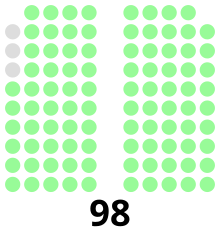 | 95 Nacionalista iii independent |
| 1946 | 2nd Republic Congress |  | ix Nacionalista (Liberal fly) 6 Nacionalista 1 Popular Front | 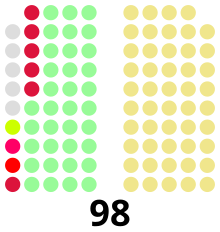 | 49 Nacionalista (Liberal wing) 35 Nacionalista 6 Democratic Brotherhood 3 others |
| 1st Congress | |||||
| 1947 |  | vi Liberal 2 Nacionalista | |||
| 1949 | second Congress |  | 8 Liberal |  | sixty Liberal 33 Nacionalista 7 others |
| 1951 |  | 8 Nacionalista | |||
| 1953 | 3rd Congress |  | five Nacionalista ii Autonomous 1 Citizens' |  | 59 Nacionalista 31 Liberal 11 Democratic i independent |
| 1955 | 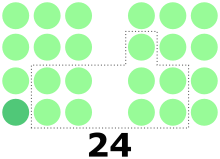 | 9 Nacionalista | |||
| 1957 | quaternary Congress |  | 6 Nacionalista 2 Liberal |  | 82 Nacionalista nineteen Liberal one NCP |
| 1959 |  | 5 Nacionalista 2 Liberal 1 NCP | |||
| 1961 | 5th Congress |  | 4 Liberal 2 Nacionalista 2 Progressive |  | 74 Nacionalista 29 Liberal 1 contained |
| 1963 | 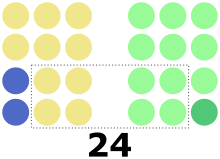 | four Liberal 4 Nacionalista | |||
| 1965 | 6th Congress | 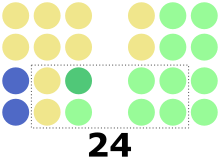 | 5 Nacionalista 2 Liberal 1 NCP |  | 61 Liberal 38 Nacionalista five others |
| 1967 |  | 6 Nacionalista one Liberal one contained | |||
| 1969 | 7th Congress |  | half-dozen Nacionalista 2 Liberal | 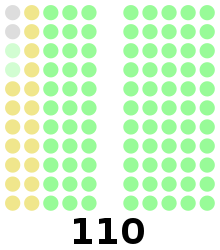 | 88 Nacionalista 18 Liberal four others |
| 1971 | 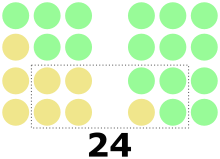 | v Liberal iii Nacionalista | |||
| 1978, 1984 | Run across Batasang Pambansa | ||||
| 1987 | eighth Congress |  | 22 LABAN 2 GAD |  | 43 PDP–Laban 24 Lakas ng Bansa 19 UNIDO 16 Liberal 11 KBL 55 coalitions 32 others 14 appointed sectoral seats |
| 1992 | ninth Congress |  | 16 LDP v NPC 2 Lakas 1 Liberal | 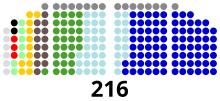 | 86 LDP 41 Lakas 30 NPC eleven LP-PDP 32 others 16 appointed sectoral seats |
| 1995 | 10th Congress |  | 4 Lakas 4 LDP ane Nacionalista i NPC i PRP 1 independent |  | 157 pro-administration coalition 26 opposition coalition 12 hybrid coalitions ix others sixteen appointed sectoral seats |
| 1998 | 11th Congress |  | 5 Lakas 4 LDP i NPC 1 PMP 1 PDP–Laban |  | 111 Lakas 55 LAMMP 15 Liberal 25 others 14 party-lists |
| 2001 | 12th Congress |  | 3 Lakas 2 LDP 1 Liberal one PDP–Laban 6 contained |  | 73 Lakas 40 NPC 21 LDP 19 Liberal 52 others 17 party-lists |
| 2004 | 13th Congress |  | 5 KNP four Lakas 2 Liberal 1 PRP |  | 92 Lakas 53 NPC 29 Liberal 15 LDP 20 others 28 political party-lists |
| 2007 | 14th Congress |  | two Liberal 2 Nacionalista two NPC ii UNO 1 KAMPI one LDP 1 PDP–Laban i independent |  | 89 Lakas 44 KAMPI 28 NPC 23 Liberal 11 Nacionalista 23 others 53 political party-lists |
| 2010 | 15th Congress |  | three Liberal 2 Lakas–Kampi 2 Nacionalista 2 PMP 1 NPC 1 PRP 1 independent |  | 106 Lakas–Kampi 47 Liberal 29 NPC 25 Nacionalista 22 others 57 party-lists |
| 2013 | 16th Congress |  | 3 Nacionalista 3 UNA ane LDP 1 Liberal 1 NPC one PDP–Laban |  | 109 Liberal 42 NPC 24 NUP eighteen Nacionalista 14 Lakas 27 others 59 party-lists |
| 2016 | 17th Congress | 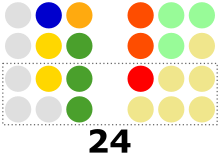 | 5 Liberal 2 NPC 1 Akbayan one UNA three independent |  | 115 Liberal 42 NPC 24 Nacionalista 23 NUP 11 UNA 23 others 59 political party-lists |
| 2019 | 18th Congress |  | 4 PDP–Laban three Nacionalista 1 Lakas one LDP ane NPC 1 UNA 1 contained |  | 82 PDP–Laban 42 Nacionalista 37 NPC 23 NUP eighteen Liberal 12 Lakas 27 others 61 party-lists |
Latest elections [edit]
Senate [edit]
In the Philippines, the almost mutual way to illustrate the effect in a Senate election is via a tally of candidates in descending order of votes. The twelve candidates with the highest number of votes are elected.
| # | Candidate | Coalition | Political party | Votes | % | ||
|---|---|---|---|---|---|---|---|
| 1. | Cynthia Villar | HNP | Nacionalista | 25,283,727 | 53.46% | ||
| two. | Grace Poe | Independent | 22,029,788 | 46.58% | |||
| 3. | Bong Go | HNP | PDP–Laban | xx,657,702 | 42.35% | ||
| iv. | Pia Cayetano | HNP | Nacionalista | 19,789,019 | 41.84% | ||
| 5. | Ronald dela Rosa | HNP | PDP–Laban | 19,004,225 | xl.18% | ||
| 6. | Sonny Angara | HNP | LDP | 18,161,862 | 38.forty% | ||
| 7. | Lito Lapid | NPC | 16,965,464 | 35.87% | |||
| 8. | Imee Marcos | HNP | Nacionalista | xv,882,628 | 33.58% | ||
| nine. | Francis Tolentino | HNP | PDP–Laban | 15,510,026 | 32.79% | ||
| 10. | Koko Pimentel | HNP | PDP–Laban | 14,668,665 | 31.01% | ||
| 11. | Bong Revilla | HNP | Lakas | 14,624,445 | xxx.92% | ||
| 12. | Nancy Binay | UNA | UNA | 14,504,936 | 30.67% | ||
| xiii. | JV Ejercito | HNP | NPC | fourteen,313,727 | 30.26% | ||
| 14. | Bam Aquino | Otso Diretso | Liberal | 14,144,923 | 29.91% | ||
| xv. | Jinggoy Estrada | HNP | PMP | 11,359,305 | 24.02% | ||
| 16. | Mar Roxas | Otso Diretso | Liberal | nine,843,288 | 20.81% | ||
| 17. | Serge Osmeña | Contained | nine,455,202 | nineteen.99% | |||
| xviii. | Willie Ong | Lakas | 7,616,265 | xvi.12% | |||
| xix. | Dong Mangudadatu | HNP | PDP–Laban | 7,499,604 | xv.86% | ||
| 20. | Jiggy Manicad | HNP | Independent | 6,896,889 | 14.58% | ||
| 21. | Chel Diokno | Otso Diretso | Liberal | 6,342,939 | 13.41% | ||
| 22. | Juan Ponce Enrile | PMP | 5,319,298 | 11.25% | |||
| 23. | Gary Alejano | Otso Diretso | Liberal | 4,726,652 | nine.99% | ||
| 24. | Neri Colmenares | Labor Win | Makabayan | 4,683,942 | 9.90% | ||
| 25. | Samira Gutoc | Otso Diretso | Liberal | 4,345,252 | 9.19% | ||
| 26. | Romulo Macalintal | Otso Diretso | Independent | 4,007,339 | 8.47% | ||
| 27. | Erin Tañada | Otso Diretso | Liberal | iii,870,529 | 8.18% | ||
| 28. | Larry Gadon | KDP | KBL | 3,487,780 | 7.37% | ||
| 29. | Florin Hilbay | Otso Diretso | Aksyon | 2,757,879 | five.83% | ||
| thirty. | Freddie Aguilar | Independent | two,580,230 | 5.46% | |||
| 31. | Glenn Chong | KDP | KDP | 2,534,335 | 5.36% | ||
| 32. | Raffy Alunan | Bagumbayan | two,059,359 | iv.35% | |||
| 33. | Faisal Mangondato | KKK | Independent | 1,988,719 | 4.20% | ||
| 34. | Agnes Escudero | KKK | Independent | ane,545,985 | 3.27% | ||
| 35. | Dado Padilla | PFP | 1,095,337 | 2.32% | |||
| 36. | Ernesto Arellano | Independent | 937,713 | 2.30% | |||
| 37. | Allan Montaño | Labor Win | Independent | 923,419 | two.25% | ||
| 38. | Leody de Guzman | Labor Win | PLM | 893,506 | 2.17% | ||
| 39. | Melchor Chavez | WPP | WPP | 764,473 | 2.06% | ||
| 40. | Vanjie Abejo | KKK | Independent | 656,006 | 2.00% | ||
| 41. | Toti Casiño | KDP | KDP | 580,853 | one.97% | ||
| 42. | Abner Afuang | WPP | WPP | 559,001 | 1.92% | ||
| 43. | Shariff Albani | WPP | WPP | 496,855 | 1.87% | ||
| 44. | Dan Roleda | UNA | UNA | 469,840 | i.lxxx% | ||
| 45. | Ding Generoso | KKK | Contained | 449,785 | 1.75% | ||
| 46. | Nur-Ana Sahidulla | KDP | KDP | 444,096 | 1.68% | ||
| 47. | Abraham Jangao | Independent | 434,697 | one.65% | |||
| 48. | Marcelino Arias | WPP | WPP | 404,513 | 1.59% | ||
| 49. | Richard Alfajora | KKK | Independent | 404,513 | 1.57% | ||
| 50. | Sonny Matula | Labor Win, WPP | WPP | 400,339 | 1.fifty% | ||
| 51. | Elmer Francisco | PFP | 395,427 | one.45% | |||
| 52. | Joan Sheelah Nalliw | KKK | Independent | 390,165 | 1.38% | ||
| 53. | Gerald Arcega | WPP | WPP | 383,749 | 1.30% | ||
| 54. | Butch Valdes | KDP | KDP | 367,851 | 1.twenty% | ||
| 55. | Jesus Caceres | KKK | Independent | 358,472 | 0.xc% | ||
| 56. | Bernard Austria | PDSP | 347,013 | 0.70% | |||
| 57. | Jonathan Baldevarona | Contained | 310,411 | 0.67% | |||
| 58. | Emily Mallillin | KKK | Independent | 304,215 | 0.64% | ||
| 59. | Charlie Gaddi | KKK | Contained | 286,361 | 0.l% | ||
| 60. | RJ Javellana | KDP | KDP | 258,538 | 0.47% | ||
| 61. | Junbert Guigayuma | WPP | WPP | 240,306 | 0.twoscore% | ||
| 62. | Luther Meniano | WPP | WPP | 159,774 | 0.thirty% | ||
| Total turnout | 47,296,442 | 74.31% | |||||
| Total votes | 362,179,156 | N/A | |||||
| Registered voters | 63,643,263 | 100.0% | |||||
| Reference: Commission on Elections sitting as the National Board of Canvassers. | |||||||
House of Representatives [edit]
A voter has two votes in the House of Representatives: one vote for a representative elected in the voter'south congressional district (first-past-the-post), and one vote for a party in the party-list organisation (airtight list), the so-chosen party-list representatives; party-list representatives shall comprise not more than 20% of the House of Representatives.
To determine the winning parties in the party-list election, a party must surpass the 2% election threshold of the national vote; usually, the political party with the largest number of votes wins the maximum three seats, the remainder 2 seats. If the number of seats of the parties that surpassed the 2% threshold is less than 20% of the total seats, the parties that won less than 2% of the vote gets one seat each until the twenty% requirement is met.
Commune elections [edit]
 | ||||||
| Party | Votes | % | +/– | Seats | +/– | |
|---|---|---|---|---|---|---|
| Partido Demokratiko Pilipino-Lakas ng Bayan | 12,653,960 | 31.22 | +29.32 | 82 | +79 | |
| Nacionalista Party | 6,524,100 | 16.10 | +6.68 | 42 | +18 | |
| Nationalist People's Coalition | 5,797,543 | fourteen.31 | −two.73 | 37 | −5 | |
| National Unity Party | 3,852,909 | nine.51 | −0.16 | 25 | +ii | |
| Liberal Party | 2,321,759 | five.73 | −35.99 | eighteen | −97 | |
| Lakas-CMD | 2,069,871 | 5.11 | +3.57 | 12 | +8 | |
| Partido Federal ng Pilipinas | 965,048 | 2.38 | New | 5 | New | |
| Hugpong ng Pagbabago | 652,318 | 1.61 | New | 3 | New | |
| Aksyon Demokratiko | 398,616 | 0.98 | −0.4 | 1 | 0 | |
| Pwersa ng Masang Pilipino | 396,614 | 0.98 | +0.77 | ane | New | |
| Bukidnon Paglaum | 335,628 | 0.83 | +0.48 | ii | +1 | |
| Pederalismo ng Dugong Dakilang Samahan | 259,423 | 0.64 | New | 0 | 0 | |
| Laban ng Demokratikong Pilipino | 252,806 | 0.62 | +0.32 | 2 | 0 | |
| United Nationalist Alliance | 232,657 | 0.57 | −6.05 | 0 | −11 | |
| Hugpong sa Tawong Lungsod | 197,024 | 0.49 | +0.35 | i | New | |
| Partidong Pagbabago ng Palawan | 185,810 | 0.46 | New | 2 | New | |
| Bileg Ti Ilokano | 158,523 | 0.39 | New | 1 | New | |
| People's Reform Party | 138,014 | 0.34 | New | i | New | |
| Unang Sigaw ng Nueva Ecija | 120,674 | 0.30 | New | 0 | 0 | |
| Katipunan ng Demokratikong Pilipino | 116,453 | 0.29 | New | 0 | 0 | |
| Asenso Abrenio | 115,865 | 0.29 | New | 1 | New | |
| Kambilan ning Memalen Kapampangan | 107,078 | 0.26 | New | 0 | 0 | |
| Padayon Pilipino | 98,450 | 0.24 | −0.10 | 0 | 0 | |
| Asenso Manileño | 84,656 | 0.21 | −0.29 | ii | 0 | |
| Kusog Bicolandia | 82,832 | 0.twenty | New | 0 | 0 | |
| Centrist Democratic Party of the Philippines | 81,741 | 0.20 | +0.16 | 1 | New | |
| Partido Navoteño | 80,265 | 0.xx | New | 1 | New | |
| Kabalikat ng Bayan sa Kaunlaran | 65,836 | 0.16 | −0.03 | i | 0 | |
| Partido Demokratiko Sosyalista ng Pilipinas | 56,223 | 0.14 | New | 0 | 0 | |
| Bagumbayan-VNP | 33,731 | 0.08 | New | 0 | 0 | |
| Kilusang Bagong Lipunan | 33,594 | 0.08 | −0.45 | 0 | 0 | |
| Adelante Zamboanga Party | 28,605 | 0.07 | New | 0 | 0 | |
| Labor Party Philippines | 9,718 | 0.02 | +0.00 | 0 | 0 | |
| Democratic Party of the Philippines | one,110 | 0.00 | New | 0 | 0 | |
| Hugpong Surigao Sur | 816 | 0.00 | New | 0 | 0 | |
| Philippine Green Republican Party | 701 | 0.00 | −0.01 | 0 | 0 | |
| Contained | ii,014,211 | four.97 | −0.86 | ii | −2 | |
| Party-list seats[b] | 61 | +2 | ||||
| Total | twoscore,525,182 | 100.00 | – | 304 | +five | |
| Valid votes | twoscore,525,182 | 86.34 | ||||
| Invalid/blank votes | 6,411,957 | 13.66 | ||||
| Full votes | 46,937,139 | – | ||||
| Registered voters/turnout | 61,843,771 | 75.ninety | ||||
| Source: COMELEC (Seats won), (Turnout and electorate) | ||||||
- ^ The URL of the website of the House of Representatives is, for case, www.congress.gov.ph.
- ^ There were supposed to be 306 seats upwardly, out of 245 districts and 61 party-seats. Elections at two districts were deferred after ballots were already printed using the quondam configuration. After the political party-list seats were seated, the Supreme Court and so ruled that ane of the districts shall first disputed in the 2022 election, and that the results of the 2022 election using the former configuration stood. The Committee on Elections then ruled that for other commune, the same ruling from the Supreme Courtroom would also be followed. This reduced the number of congressional district seats to 243, and would accept meant a reduction of i party-list seat, but that was no longer acted upon.
Political party-listing election [edit]
| Party | Votes | % | +/– | Seats | +/– | |
|---|---|---|---|---|---|---|
| Anti-Criminal offense and Terrorism Community Interest and Support | 2,651,987 | ix.51 | +9.17 | 3 | New | |
| Bayan Muna | ane,117,403 | 4.01 | +2.14 | three | +ii | |
| Ako Bicol Political Party | ane,049,040 | 3.76 | −1.38 | ii | −ane | |
| Citizens' Boxing Confronting Corruption | 929,718 | 3.33 | +1.61 | 2 | +1 | |
| Alyansa ng mga Mamamayang Probinsyano | 770,344 | two.76 | New | 2 | New | |
| Ane Patriotic Coalition of Marginalized Nationals | 713,969 | two.56 | −i.49 | ii | 0 | |
| Marino Samahan ng mga Seaman | 681,448 | 2.44 | +2.12 | ii | New | |
| Probinsyano Ako | 630,435 | ii.26 | New | 2 | New | |
| Coalition of Association of Senior Citizens in the Philippines | 516,927 | i.85 | −1.xx | 1 | −i | |
| Magkakasama sa Sakahan Kaunlaran | 496,337 | 1.78 | New | 1 | New | |
| Association of Philippine Electric Cooperatives | 480,874 | 1.72 | New | 1 | New | |
| Gabriela Women's Political party | 449,440 | i.61 | −ii.61 | 1 | −1 | |
| An Waray | 442,090 | 1.59 | −0.23 | i | 0 | |
| Cooperative NATCCO Network Party | 417,285 | 1.50 | −0.57 | 1 | −i | |
| Human activity Teachers | 395,327 | i.42 | −two.23 | i | −1 | |
| Philippine Rural Electrical Cooperatives Association | 394,966 | 1.42 | New | 1 | New | |
| Ako Bisaya | 394,304 | 1.41 | New | i | New | |
| Tingog Sinirangan | 391,211 | 1.40 | +0.75 | one | New | |
| Abono | 378,204 | 1.36 | −0.90 | 1 | −1 | |
| Buhay Hayaan Yumabong | 361,493 | one.30 | −1.05 | one | −ane | |
| Duterte Youth | 354,629 | 1.27 | New | 1 | New | |
| Kalinga-Advocacy for Social Empowerment and Nation Edifice Through Easing Poverty | 339,665 | one.22 | New | 1 | 0 | |
| Puwersa ng Bayaning Atleta | 326,258 | 1.17 | −i.24 | 1 | −1 | |
| Alliance of Organizations Networks and Associations of the Philippines | 320,000 | ane.15 | −0.19 | 1 | 0 | |
| Rural Electric Consumers and Beneficiaries of Development and Advancement | 318,511 | 1.14 | New | 1 | New | |
| Bagong Henerasyon | 288,752 | ane.04 | +0.12 | 1 | 0 | |
| Bahay para sa Pamilyang Pilipino | 281,793 | 1.01 | New | 1 | New | |
| Structure Workers Solidarity | 277,940 | 1.00 | +0.97 | ane | New | |
| Abang Lingkod | 275,199 | 0.99 | −0.45 | ane | 0 | |
| Advocacy for Teacher Empowerment Through Activeness, Cooperation and Harmony Towards Educational Reforms | 274,460 | 0.98 | −0.49 | 1 | 0 | |
| Barangay Health Wellness | 269,518 | 0.97 | New | 1 | New | |
| Social Amelioration and Genuine Intervention on Poverty | 257,313 | 0.92 | −0.31 | i | New | |
| Merchandise Union Congress Political party | 256,059 | 0.92 | −0.52 | 1 | 0 | |
| Magdalo para sa Pilipino | 253,536 | 0.91 | +0.05 | 1 | 0 | |
| Galing sa Puso Party | 249,484 | 0.89 | New | 1 | New | |
| Manila Teachers Savings and Loan Association | 249,416 | 0.89 | +0.06 | one | 0 | |
| Rebolusyonaryong Alyansa Makabansa | 238,150 | 0.85 | +0.38 | 1 | New | |
| Alagaan Natin Ating Kalusugan | 237,629 | 0.85 | +0.26 | 1 | New | |
| Ako Padayon Pilipino | 235,112 | 0.84 | New | 1 | New | |
| Ang Asosayon Sang Mangunguma Nga Bisaya-Owa Mangunguma | 234,552 | 0.84 | −0.69 | 1 | 0 | |
| Kusug Tausug | 228,224 | 0.82 | +0.06 | one | 0 | |
| Dumper Philippines Taxi Drivers Association | 223,199 | 0.lxxx | +0.78 | ane | New | |
| Talino at Galing ng Pinoy | 217,525 | 0.78 | +0.51 | 1 | New | |
| Public Prophylactic Alliance for Transformation and Rule of Law | 216,653 | 0.78 | New | 1 | New | |
| Anak Mindanao | 212,323 | 0.76 | −one.42 | ane | −1 | |
| Agronomical Sector Alliance of the Philippines | 208,752 | 0.75 | −one.08 | i | 0 | |
| LPG Marketers Association | 208,219 | 0.75 | −0.69 | ane | 0 | |
| OFW Family Club | 200,881 | 0.72 | +0.09 | 1 | New | |
| Kabalikat ng Mamamayan | 198,571 | 0.71 | −1.89 | i | −1 | |
| Democratic Independent Workers Clan | 196,385 | 0.seventy | −0.74 | i | New | |
| Kabataan | 195,837 | 0.70 | −0.23 | 1 | 0 | |
| Aksyon Magsasaka-Partido Tinig ng Masa | 191,804 | 0.69 | New | 0 | 0 | |
| Serbisyo sa Bayan Political party | 180,535 | 0.65 | −0.22 | 0 | −ii | |
| Angkla: ang Partido ng mga Pilipinong Marino | 179,909 | 0.65 | −0.39 | 0 | −i | |
| Akbayan | 173,356 | 0.62 | −1.26 | 0 | −1 | |
| Wow Pilipinas Motion | 172,080 | 0.62 | New | 0 | 0 | |
| Ina na Nagmamahal sa Anak | 170,019 | 0.61 | New | 0 | 0 | |
| Y'all Against Corruption and Poverty | 167,826 | 0.threescore | −0.86 | 0 | −ane | |
| Abante Mindanao | 166,883 | 0.60 | −0.05 | 0 | 0 | |
| Butil Farmers Political party | 164,412 | 0.59 | −0.63 | 0 | −one | |
| Append | 158,003 | 0.57 | New | 0 | 0 | |
| Anakpawis | 146,511 | 0.53 | −0.60 | 0 | −1 | |
| Ang National Coalition of Ethnic People Action Na! | 144,291 | 0.52 | −0.46 | 0 | −1 | |
| Ang Nars | 141,263 | 0.51 | −0.17 | 0 | 0 | |
| Partido ng Bayan and Bida | 136,093 | 0.49 | New | 0 | 0 | |
| Kasosyo Producer-Consumer Exchange Association | 134,795 | 0.48 | New | 0 | 0 | |
| Agri-Agra na Reporma para sa Magsasaka ng Pilipinas Movement | 133,505 | 0.48 | −ii.x | 0 | −two | |
| Acts Overseas Filipino Workers Coalition of Organizations | 131,865 | 0.47 | −0.69 | 0 | −1 | |
| Adhikaing Tinaguyod ng Kooperatiba | 131,344 | 0.47 | +0.10 | 0 | 0 | |
| Ang Mata'y Alagaan | 128,201 | 0.46 | −0.56 | 0 | −1 | |
| 1st Consumers Alliance for Rural Energy | 127,867 | 0.46 | New | 0 | −1 | |
| Murang Kuryente Partylist | 127,530 | 0.46 | New | 0 | 0 | |
| Una ang Edukasyon | 119,646 | 0.43 | −0.43 | 0 | −1 | |
| Philippine Educators Alliance for Community Empowerment | 119,211 | 0.43 | New | 0 | 0 | |
| Association of Lady Entrepreneurs | 113,134 | 0.41 | New | 0 | 0 | |
| Aangat Tayo | 109,939 | 0.39 | −0.36 | 0 | −1 | |
| Ako An Bisaya | 109,463 | 0.39 | −0.11 | 0 | 0 | |
| Avid Builders of Active Nation'southward Citizenry Towards Empowered Philippines | 97,114 | 0.35 | New | 0 | 0 | |
| Alay Buhay Community Evolution Foundation | 94,320 | 0.34 | −0.24 | 0 | 0 | |
| Global Workers and Family unit Federation | 89,775 | 0.32 | −0.04 | 0 | 0 | |
| Confederation of Non-Stock Savings and Loan Associations | 88,075 | 0.32 | −0.34 | 0 | 0 | |
| Abe Kapampangan | 83,379 | 0.30 | New | 0 | 0 | |
| National Association for Electricity Consumers for Reforms | 81,141 | 0.29 | New | 0 | 0 | |
| Philippine National Police Retirees Association | 79,818 | 0.29 | New | 0 | 0 | |
| Kilusang Maypagasa | 79,358 | 0.28 | New | 0 | 0 | |
| Joint Marriage of Active Nationalist Filipino Movement | 76,769 | 0.28 | New | 0 | 0 | |
| Tanggol Maralita | 76,428 | 0.27 | −0.15 | 0 | 0 | |
| Ating Agapay Sentrong Samahan ng mga Obrero | 74,722 | 0.27 | −0.64 | 0 | −1 | |
| one Brotherhood Advocating Autonomy Party | 74,465 | 0.27 | New | 0 | 0 | |
| Ang Kabuhayan | 74,229 | 0.27 | −0.81 | 0 | −ane | |
| Agbiag! Timpuyog Ilocano | 70,318 | 0.25 | −0.49 | 0 | −1 | |
| Abakada Guro | 69,257 | 0.25 | −0.42 | 0 | 0 | |
| Alliance of Philippine Line-fishing Federations | 69,138 | 0.25 | −0.43 | 0 | 0 | |
| Ang Laban ng Indiginong Filipino | 68,805 | 0.25 | −0.77 | 0 | 0 | |
| Laang Kawal ng Pilipinas | 68,333 | 0.25 | New | 0 | 0 | |
| Sinag Tungo sa Kaunlaran | 61,696 | 0.22 | +0.03 | 0 | 0 | |
| People'southward Champ Guardians | 60,448 | 0.22 | New | 0 | 0 | |
| Luntiang Pilipinas Partylist | 59,096 | 0.21 | New | 0 | 0 | |
| Grains Retailers Confederation of the Philippines | 58,561 | 0.21 | New | 0 | 0 | |
| Alliance of National Urban Poor Organisation Assembly | 54,767 | 0.20 | +0.14 | 0 | 0 | |
| Ako Bisdak-Bisayang Dako | 51,228 | 0.18 | New | 0 | 0 | |
| Kooperatiba-Kapisanan ng Magsasaka ng Pilipinas | 50,889 | 0.18 | New | 0 | 0 | |
| Spousal relationship of Nationalistic Autonomous Filipino Organization | 45,710 | 0.16 | +0.01 | 0 | 0 | |
| Isang Lapian ng Mangingisda at Bayan Tungo sa Kaunlaran | 44,181 | 0.16 | New | 0 | 0 | |
| Ako Ayoko sa Bawal na Droga | 43,583 | 0.xvi | New | 0 | 0 | |
| Barangay Natin | forty,899 | 0.fifteen | +0.05 | 0 | 0 | |
| i-United Send Koalisyon | 36,285 | 0.13 | New | 0 | 0 | |
| AMEPA OFW Admission Center | 35,373 | 0.13 | −0.24 | 0 | 0 | |
| Academicians Students and Educators Alliance Inc. | 32,464 | 0.12 | −0.27 | 0 | 0 | |
| Arts, Business and Science Professionals | 31,394 | 0.11 | −0.82 | 0 | −1 | |
| Sulong Dignidad Party | 29,830 | 0.xi | New | 0 | 0 | |
| Kabalikat ng Nagkakaisang Manileño | 29,187 | 0.ten | New | 0 | 0 | |
| Parents Teacher Alliance | 28,908 | 0.x | New | 0 | 0 | |
| Partido Lakas ng Masa | 28,824 | 0.10 | New | 0 | 0 | |
| Partido ng Manggagawa | 28,351 | 0.x | New | 0 | 0 | |
| Move for Economic Transformation and Righteous Opportunities | 28,261 | 0.10 | −0.19 | 0 | 0 | |
| One Advancement for Wellness Progress and Opportunity | 26,564 | 0.10 | −0.07 | 0 | 0 | |
| Ang Tao Muna at Bayan | 25,946 | 0.09 | +0.00 | 0 | 0 | |
| Brotherhood of Volunteer Educators | 25,025 | 0.09 | −0.40 | 0 | 0 | |
| Awareness of Keepers of the Surroundings | 24,780 | 0.09 | +0.00 | 0 | 0 | |
| One Unified Transport Brotherhood of the Philippines-Bicol Region | 22,948 | 0.08 | New | 0 | 0 | |
| One Philippines | 21,974 | 0.08 | New | 0 | 0 | |
| Partido Sandugo | 19,649 | 0.07 | New | 0 | 0 | |
| Pinagbuklod na Filipino para sa Bayan | xviii,297 | 0.07 | New | 0 | 0 | |
| Federation of International Cable TV and Telecommunications Association of the Philippines | 16,038 | 0.06 | −0.05 | 0 | 0 | |
| Tribal Communities Association of the Philippines | 15,731 | 0.06 | −0.10 | 0 | 0 | |
| Tinderong Pinoy Party | 14,580 | 0.05 | −0.09 | 0 | 0 | |
| Pilipinas para sa Pinoy | 13,848 | 0.05 | New | 0 | 0 | |
| Kaisahan ng mga Maliliit na Magsasaka | 12,061 | 0.04 | −0.09 | 0 | 0 | |
| Noble Advancement of Marvelous People of the Philippines | 11,751 | 0.04 | New | 0 | 0 | |
| Filipino Family Party | 10,589 | 0.04 | New | 0 | 0 | |
| Alliance of Public Send System | 8,883 | 0.03 | New | 0 | 0 | |
| Kamais Pilipinas (Kapatirang Magmamais ng Pilipinas) | 7,571 | 0.03 | New | 0 | 0 | |
| Sandigan ng mga Manggagawa sa Konstruksyon | 6,344 | 0.02 | New | 0 | 0 | |
| Total | 27,884,790 | 100.00 | – | 61 | +2 | |
| Valid votes | 27,884,790 | 58.96 | −13.02 | |||
| Invalid/blank votes | xix,411,652 | 41.04 | +13.02 | |||
| Total votes | 47,296,442 | – | – | |||
| Registered voters/turnout | 63,643,263 | 74.31 | −6.39 | |||
| Source: COMELEC | ||||||
See also [edit]
- Politics of the Philippines
- Senate of the Philippines
- House of Representatives of the Philippines
- Legislative districts of the Philippines
- List of Philippine Senate committees
- List of Philippine House committees
- List of legislatures by country
- List of current members of the Congress of the Philippines past wealth
Notes [edit]
References [edit]
- ^ a b c d "Article Half-dozen: THE LEGISLATIVE Department". Philippines Official Gazette . Retrieved May 31, 2013.
- ^ a b c d e f m h i j chiliad "The Legislative Branch". Philippines Official Gazette. Philippines Official Gazette. Retrieved May 31, 2013.
- ^ "The City Council of Manila". Manila Standard. June 24, 2002. Retrieved December 13, 2012.
- ^ a b Elizalde, María Dolores (September 2013). "The Philippines at the Cortes de Cádiz". Philippine Studies: Historical and Ethnographic Viewpoints. 61 (3): 331–361. doi:10.1353/phs.2013.0014. hdl:10261/165907. S2CID 145232653.
Sources [edit]
- Ramirez, Efren 5. and Lee, Jr., German 1000., The New Philippine Constitution. Cebu City: 1987: pp. 142–173.
- Commodity VI of the 1987 Philippine Constitution
- How a Bill becomes a Law
- Legislative History
- Your Legislature
External links [edit]
- Official Website of the Senate
- Official Website of the House of Representatives
Source: https://en.wikipedia.org/wiki/Congress_of_the_Philippines

Post a Comment for "Qualifications for House of Representatives in the Philippines"